
How I Ended Up Photographing a Scorpion.
It all started about a year ago, in 2024, while I was photographing a Noisy Pitta. I was fully camouflaged, sitting motionless in the undergrowth, when I heard footsteps approaching. Not wanting to cause a heart attack by suddenly materializing in front of someone, I stood up and revealed myself.
The man was a city council worker collecting seeds in the area. We struck up a conversation about wildlife, and during our chat, he casually mentioned that just a short distance away, black scorpions could be found under almost every rock. That little piece of information lodged itself in my memory. I didn’t act on it right away, but when I finally invested in a macro lens, I knew I had a new project: photographing a scorpion.
When I returned to the area he described, I was surprised to find fewer rocks than expected. I walked a two-kilometre stretch, flipping nearly every stone along the way — nothing. Just as I was about to turn back, having mentally set a limit for how far I’d go, I lifted one last rock… and there it was: the elusive scorpion.
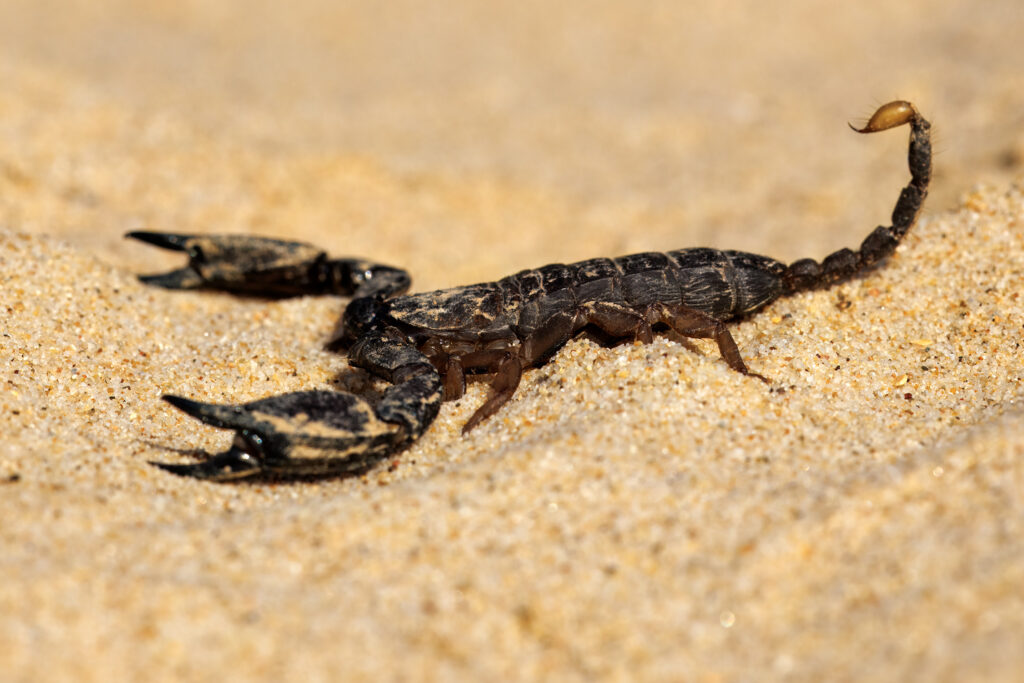
My initial vision was to photograph a scorpion in a desert-like setting — golden sands and stark shadows. Since I don’t live near a desert, I figured a local beach might do. I carefully transported the scorpion there, all while diving deep into research about Australian scorpions. I learned there are around 100 species in Australia. Thankfully, unlike their infamous African cousins, none are deadly. Still, their sting can pack a punch — comparable to a large bee or wasp—so I always wore gloves when handling the container.
The beach shoot didn’t go as planned. The sand lacked those beautiful, rippling dunes typical of deserts, and the scorpion itself was covered in mud and debris from its rock hideout. I had no idea how to clean it — what would you do? A tiny scorpion wash-and-groom session wasn’t in my skillset.
During my research, I discovered that scorpions fluoresce under UV light. Fascinated, I ordered a UV torch. Time was tight — I needed to release the scorpion soon, and I still hadn’t gotten the shot I wanted. I learned they only eat every few days, so I fed it bugs I caught myself, hoping that would tide it over.
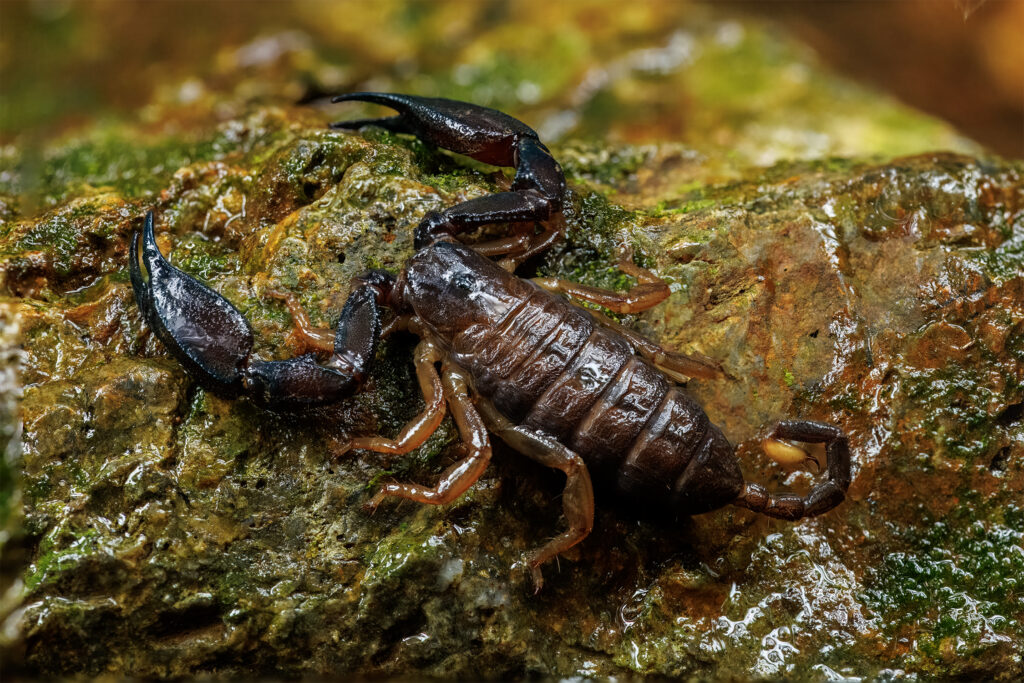
With the beach shoot a bust, I decided to photograph the scorpion in its natural environment — somewhere lush and mossy. I imagined it perched on a vibrant green rock. To keep it from scuttling away mid-session, I placed the rock in the middle of a creek, hoping the water would serve as a natural boundary.
That was the plan, at least…
Instead, the scorpion started running laps around the rock, dipping both pincers into the water repeatedly. At first, I couldn’t figure out what it was doing — until it suddenly leapt into the creek, latched onto the bottom, and began walking across the stream bed, fully submerged. That’s when it hit me: the scorpion had been using its pincers to gauge the strength and direction of the current, calculating the shortest and safest path to the shore before making its move. It was a remarkable display of instinct and problem-solving. And, to top it off, the little escape artist finally came out sparkling clean.
The photo session that followed was… intense. Camera in one hand, gloved hand ready to gently place and reposition the scorpion, constantly squatting, stepping back to focus, and just as I’d frame the shot—it would move again. After 30 or 40 minutes of this cardio-intensive “macro workout,” I managed to capture just one usable photo.
It was time to bring it back to where I’d found it. Camera in one hand, rock in the other, I began walking back. That’s when the scorpion decided it wanted to get to know me better — it started climbing up my glove. Within seconds it was just millimetres from my bare wrist. I panicked. I tried shaking it off, but it held on with impressive strength. I ended up flinging the entire glove. The glove flew one way, the scorpion the other, and my heart almost exploded.
After catching my breath, I realized I’d accidentally released it several kilometres from its home. I felt a bit guilty — what if it didn’t like its new neighbourhood? To ease my conscience, I flipped a few rocks nearby to see if others lived there. Under the second rock – bingo – another scorpion. Hopefully, my little friend would have company.
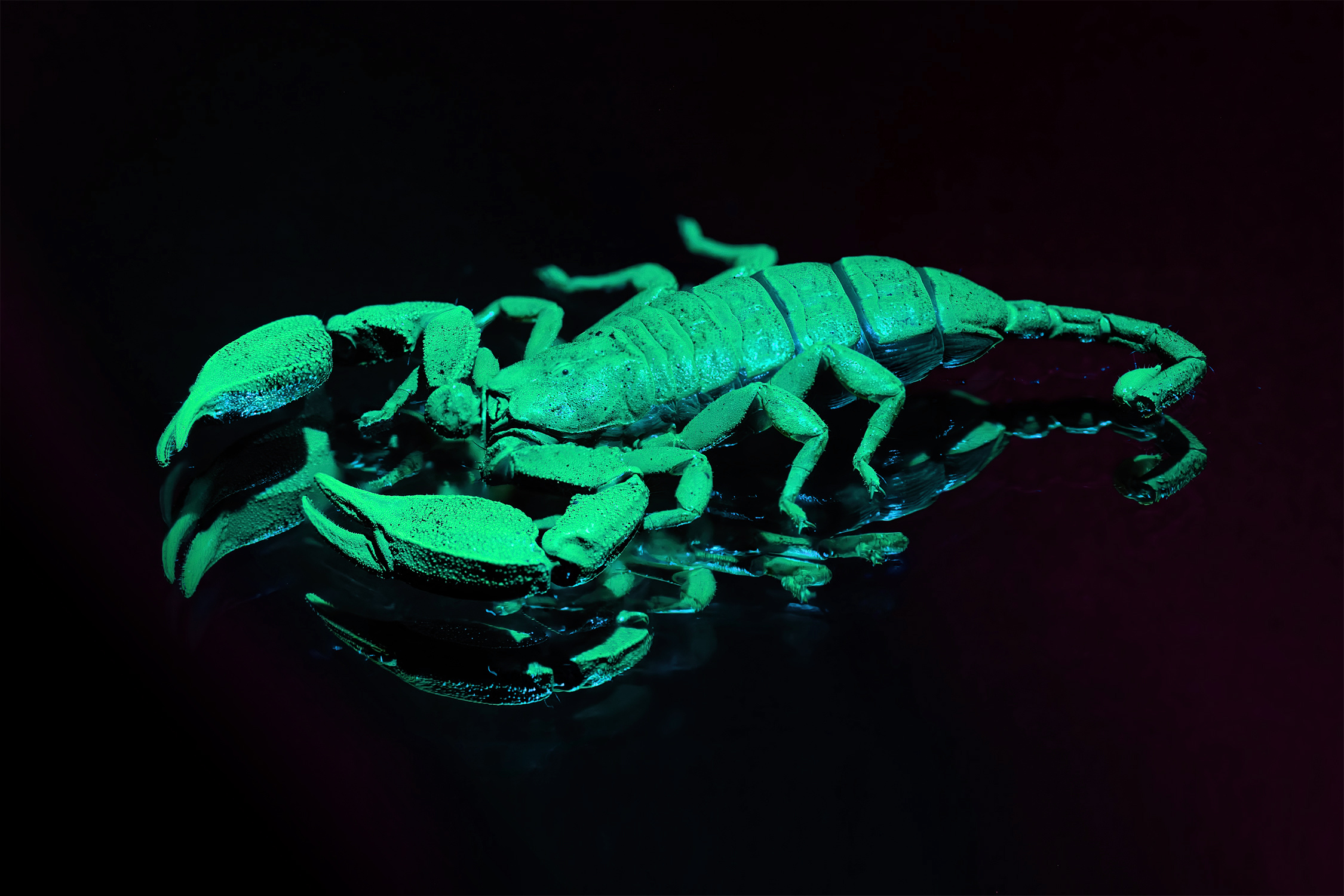
When my UV torch finally arrived, I returned to the new area at night. On a short walk, I found three scorpions. I picked the largest to be my model. That night, with a mirror set up and my son holding the UV torch, I finally captured the shots I’d been dreaming of. Under UV light, the scorpion glowed an eerie, radioactive green. The camera’s white balance went haywire in the darkness, rendering the photos a surreal blue. But honestly? Both versions looked amazing, so I kept and sharing them here. Let me know in the comments below, which photo do you personally like more?
In the final images, you can even make out the tiny eyes of the scorpion — an incredible detail that most people never get to see.
And now? I’m not sure how keen I am to return to that park at night, knowing just how many creatures are hiding beneath every rock. But again… things like this never stopped me before.

Leave a Reply