
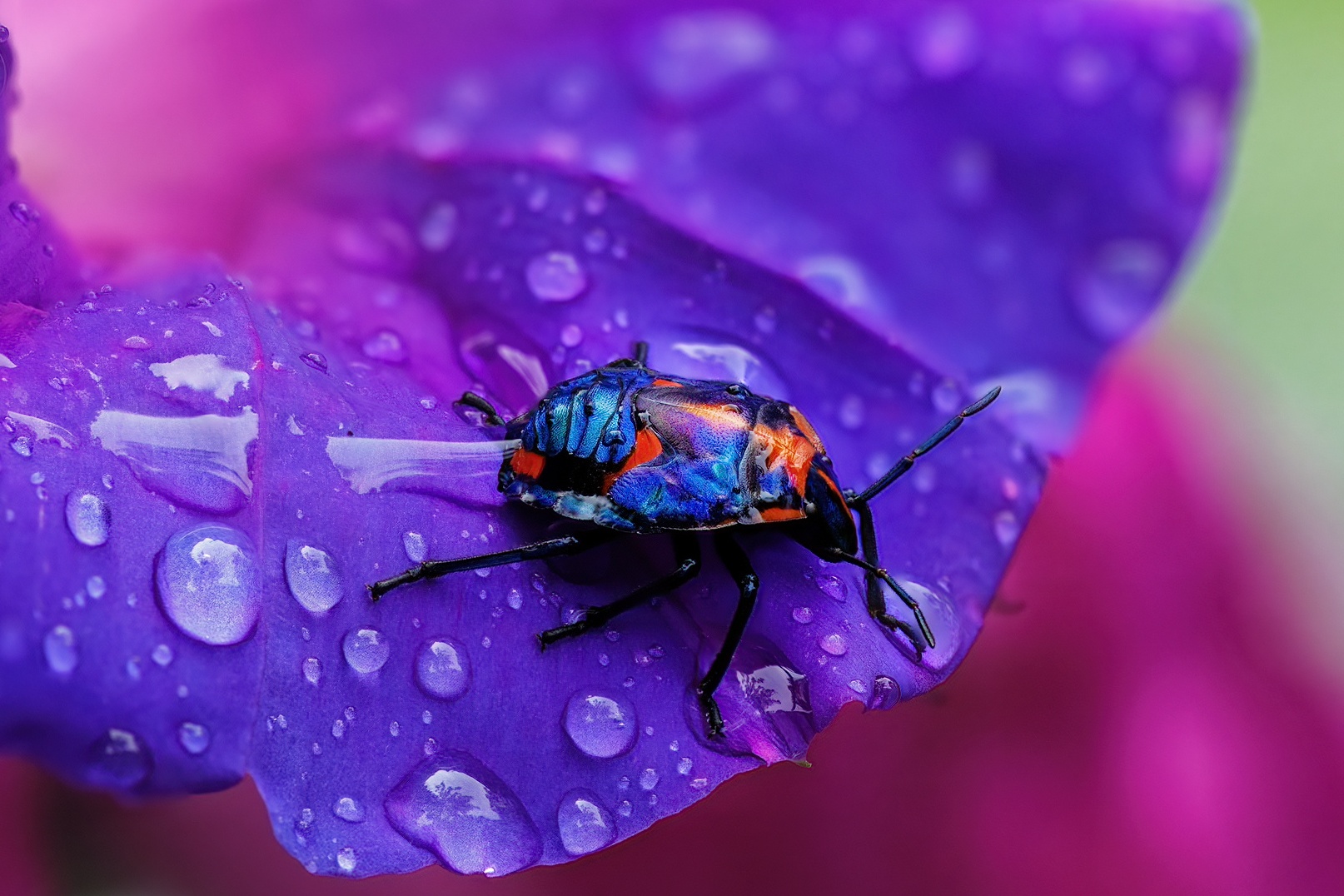
I often joke that I was born with a camera in my hands. Over the years, I’ve explored a wide range of photographic styles—panoramic landscapes, infrared scenes, long-lens wildlife work, and more. Each genre brought its own challenges and rewards, and I embraced them with curiosity and passion.
But one area I deliberately avoided was macro photography. Not because it lacked appeal, but because I feared falling too deeply for it. The idea of spending my days crawling through undergrowth, chasing insects the size of a grain of rice, didn’t seem all that glamorous. I knew myself well enough to recognize that if I gave it a try, I’d probably get hooked—and I wasn’t sure I was ready for that kind of commitment.
However, after years of wildlife photography—particularly after photographing over 60% of Australia’s bird species—I began to feel the creative itch again. As the opportunities for new and exciting avian subjects dwindled, I found myself in a lull. Boredom crept in. And that’s when I finally gave in and picked up a macro lens.
What I discovered was a world more intricate and challenging than I’d imagined. Macro photography is intensely technical. The shallow depth of field demands that you get close—really close—to your subject. But that proximity often causes it to flee. Achieving tack-sharp focus is a constant battle. Stop the lens down beyond f/11, and images start to lose their crispness due to diffraction. Open wider than f/7, and the razor-thin depth of field forces you into the realm of focus stacking—a technique that requires shooting multiple frames at different focus points and blending them later. But stacking only works if your subject, and the environment around it, stay perfectly still—no easy task when you’re outdoors and every breeze becomes your enemy.
As with any new photographic style, I started with the basics. My first macro subjects were the easiest and most forgiving—flowers. They don’t move, they don’t mind how close you get, and they’re full of colour and texture. I especially enjoyed photographing them after rain, when droplets clung delicately to petals and leaves, adding a layer of mood and detail. Those early sessions taught me how to handle the razor-thin depth of field, how to compose within such a small frame, and how to manage light and contrast on a micro scale.
From there, I started to explore one of the most fascinating aspects of macro work—the ability to zoom in and keep zooming, revealing details invisible to the naked eye. One of my favourite series so far features a common house gecko. In the first image, you see an animal, perched against a neutral background. In the next, the frame tightens around its head, drawing attention to the texture and pattern of its skin. And in the final shot, I’ve zoomed in so close that you can see the reflection of clouds in its eye. That moment perfectly captured what I love about macro: the ability to discover entire landscapes in a single square centimetre.
It took some time, and plenty of trial and error, but gradually my results began to improve. And, as I feared, the more I practiced, the more I fell in love with it. While bird photography remains my primary passion, macro photography has carved out its own irresistible niche in my creative life.
I now find myself drawn not just to the tiny creatures themselves, but to the stories their environments can tell. To truly elevate my macro work, I know I need to focus more on composition and backgrounds—on creating images that aren’t just technically sharp, but also emotionally engaging. That will come with time and patience.
One unexpected challenge I’ve encountered in this journey is the identification of the subjects I photograph. Unlike birds—where field guides and online databases make species recognition relatively straightforward—the world of insects is incredibly vast, diverse, and often under-documented. Many species can be nearly impossible to identify without expert knowledge or even microscopic examination.
As a result, I’ve chosen not to provide species names for every photo from the set of photos below. My focus at this stage has been on exploring the art and technique of macro photography rather than diving deep into taxonomy. I hope you’ll enjoy these images for their visual storytelling, detail, and character, even without a scientific label attached.
This collection represents the early steps of what I suspect will become a long-term fascination—and perhaps obsession—with the tiny, intricate world hiding in plain sight.


Leave a Reply