
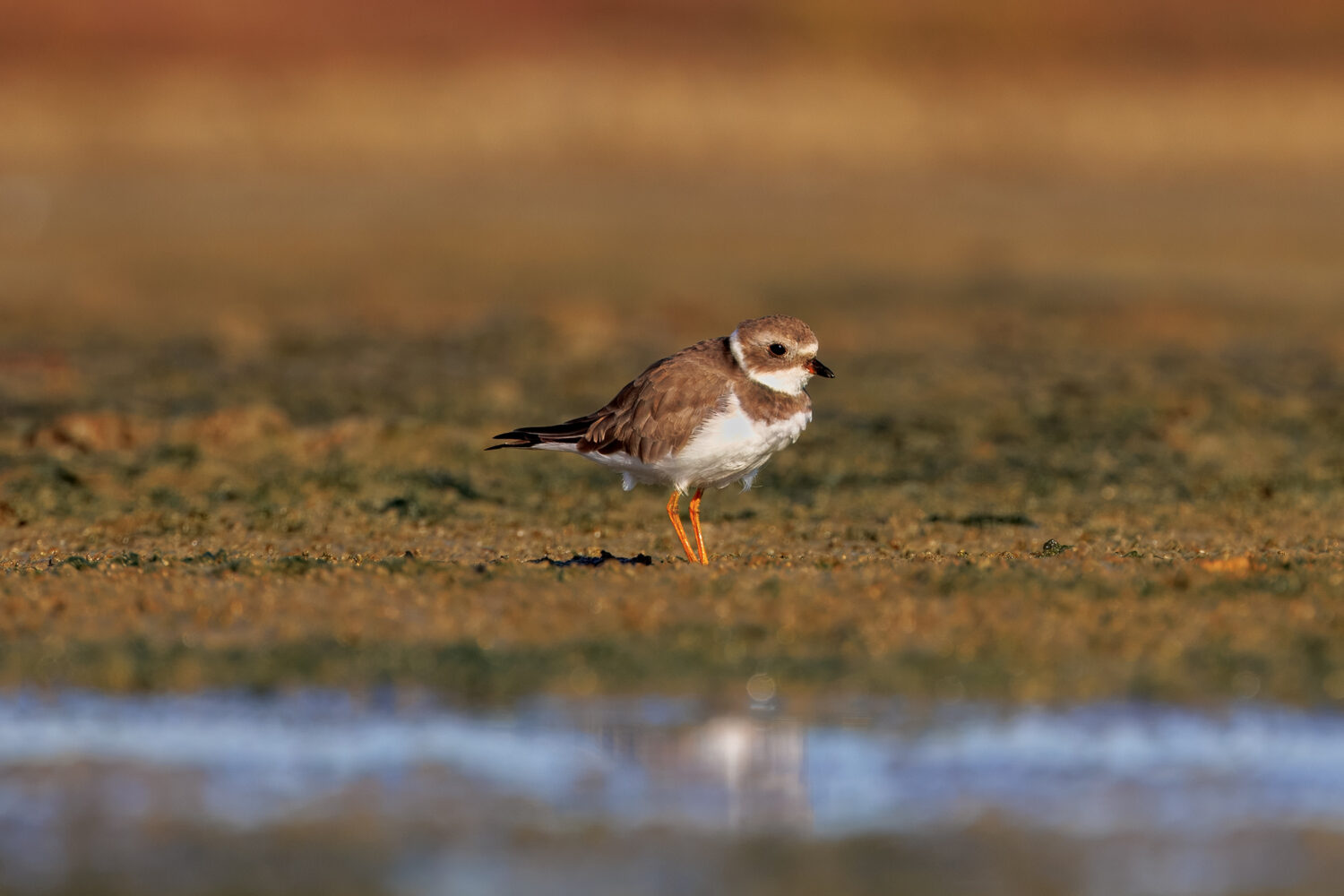
The Year an Arctic Wanderer Found Australia
For me, the story started in 2021, when a single Semipalmated Plover quietly rewrote Australian birding history. This small, compact shorebird — a species that breeds in the Arctic and typically migrates between North and South America — had somehow crossed the Pacific and arrived in Australia. Not as part of a flock. Not as one of many vagrants. But as the only individual of its kind in the entire country.
Interesting facts
- Semipalmated Means Partly Webbed. Unlike many other plovers, this species has partial webbing between its toes. The name “semipalmated” literally refers to these small webs, which likely help it move efficiently across soft mud and wet sand — a subtle but clever adaptation for life on tidal flats.
- An Arctic Breeder. Semipalmated plovers nest in the high Arctic tundra, often on sparsely vegetated gravel ridges. Their nests are simple scrapes in the ground, sometimes lined with tiny pebbles or bits of lichen — beautifully camouflaged against the stark landscape.
- A Marathon Migrant. This bird undertakes long migratory journeys between Arctic breeding grounds and wintering areas that can extend as far south as Brazil. Some individuals cross the Gulf of Mexico in a single flight — an extraordinary feat for a bird barely 18 cm long.
- The Classic “Run-Stop-Peck” Style. If you’ve photographed them feeding, you’ve probably noticed the signature plover technique: quick sprint, abrupt stop, sudden peck at prey. They rely heavily on vision, scanning for tiny invertebrates — marine worms, crustaceans, and insects — before darting in with precision.
- A Bold Breeding Look. In breeding plumage, the semipalmated plover has: A crisp white belly, brown upperparts, a single bold black breast band, a distinctive orange-and-black bill, bright orange legs. The strong facial pattern — dark mask, white forehead, and sharp contrast lines — makes them especially photogenic, particularly in clean coastal light.
- Masters of Distraction. When predators approach the nest, adults may perform a dramatic “broken-wing display”, fluttering along the ground as if injured to lure threats away from their eggs or chicks. It’s a theatrical and effective survival strategy.
A Bird That Rewrote Australian Records
For several consecutive years, a single Semipalmated Plover quietly rewrote Australian birding history.
A Hemisphere Off Course
This small Arctic-breeding shorebird — a species normally found migrating between North and South America — somehow crossed the Pacific and arrived in Australia. Not as part of a flock. Not as one of many vagrants. But as the only individual of its kind in the entire country. And it chose a wetland five minutes from my home.
A Navigational Error of Epic Scale
For a bird that typically nests on the tundra of northern Canada and winters along the coasts of the Americas, Australia is wildly off-course. Its presence here was the result of navigational error on a staggering scale — a migration gone astray by thousands of kilometres. Yet there it was: feeding calmly along the muddy margins, running, stopping, pecking, as though it had always belonged. For several years in a row, it returned.
Fidelity in a Foreign Land
That detail is perhaps the most astonishing of all. Vagrant birds appear unexpectedly, often briefly, then vanish. But this individual showed site fidelity to a place half a world away from its normal range. It survived. It navigated. It came back.
A Global Rarity on My Local Patch
From a photographer’s perspective, the experience felt almost surreal. A species that birders in Australia could only dream of — normally requiring a trip to the Arctic or the Americas — was suddenly part of my local patch. No airport. No expedition. Just a short walk from home.
When a Mistake Becomes a Gift
There’s something deeply humbling about that. Migration is one of nature’s great feats of precision — and occasionally, of profound error. This bird’s journey was likely the result of a misaligned compass, weather displacement, or a young bird imprinting on the wrong migratory route. Yet what began as a mistake became a gift: an opportunity to observe and photograph rarest species in the country far beyond its expected world.
Join the Conversation
Encounters like this remind us why we watch birds in the first place — because at any moment, the unexpected can step quietly into view. Have you ever experienced a rare visitor on your local patch? Or witnessed a migration moment that stopped you in your tracks?
I’d love to hear your thoughts.Leave a comment below and share your experiences, reflections, or questions about this remarkable Semipalmated Plover. Your stories and insights are part of what make the birding and nature photography community so special — and I’m always keen to continue the conversation.

Leave a Reply