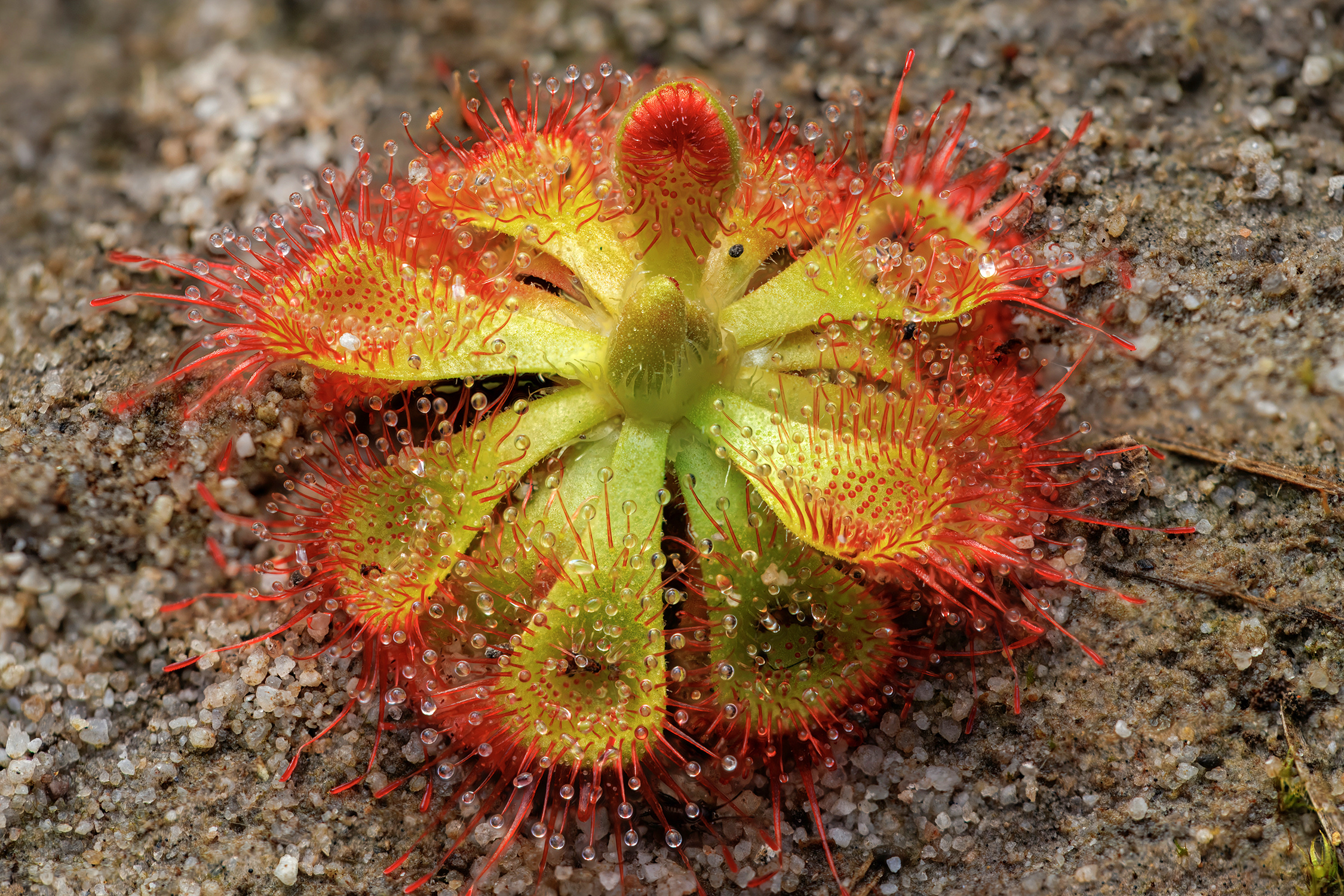
Sundews (genus Drosera) are some of the most intriguing and otherworldly plants found in Australia’s wild places. These carnivorous plants have evolved sticky, glistening leaves covered in glandular hairs tipped with mucilage — what looks like morning dew is actually a cunning trap. This “dew” lures insects in, only for them to become stuck and digested by the plant for essential nutrients, particularly in the nutrient-poor soils where sundews often grow.
Australia is home to the greatest diversity of sundews anywhere in the world, with over 100 native species. They range in form from tiny ground-huggers to taller, upright varieties, often hiding in plain sight among grasses and heathland.
Tiny But Deadly: Why I Turned My Lens on Sundews
Since adding a macro lens to my kit, I’ve been drawn to subjects that are both small and unique — and sundews tick both boxes in spades. But finding them? That was another story entirely.
After some local research, I came across a report mentioning that sundews were growing only 15 minutes from home. That was all the motivation I needed. I packed my gear and set out the very next day, eager for a macro adventure.
The first hour wasn’t easy. I had only a rough idea of the habitat they preferred and no clue what size I should be looking for. After a 2km hike, I finally found the first one. The moment of discovery was almost comical — I’d likely walked over dozens before spotting one. They’re extremely low to the ground, with their round, sticky leaves blending perfectly into the grassy environment.
Through the Lens: Photographing Carnivorous Jewels
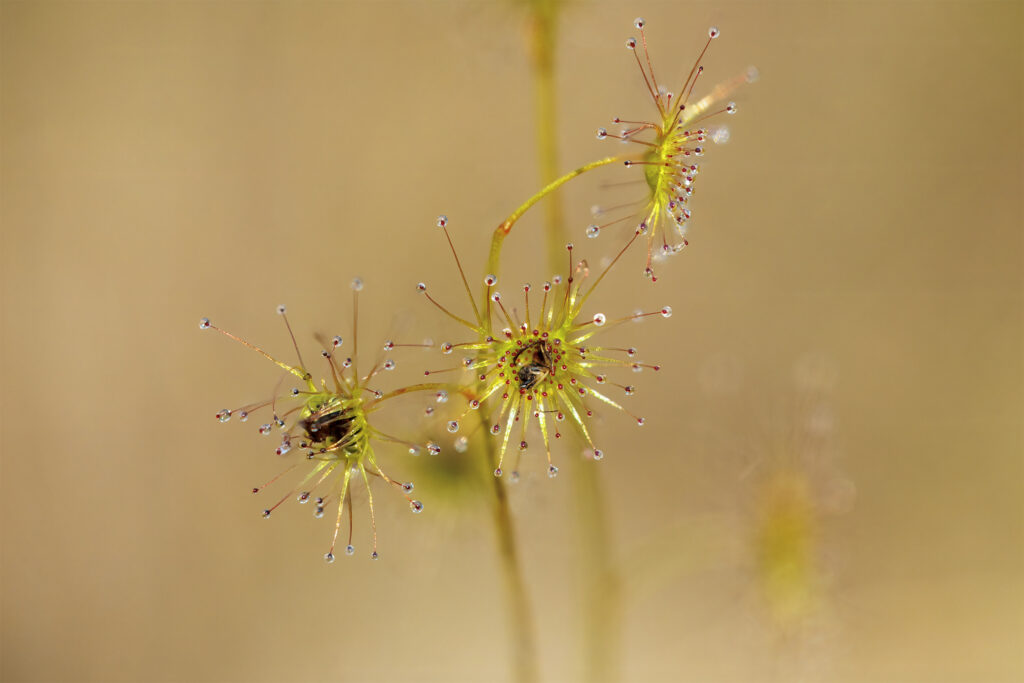
Once I knew what I was looking for, I spotted them everywhere. I discovered two distinct species during the shoot — one was short and rounded, hugging the soil, while the other stood tall on delicate stems with tiny leaves dotted along them.
Using maximum magnification, I focused in on the intricate detail of the leaves, each covered in glistening droplets. At the time, I couldn’t tell whether they had any insects caught, but the detail revealed in the photos was reward enough. Only later, while reviewing the images on a larger screen, did I realise I had captured a tiny sundew in the process of digesting its prey — a fascinating and unexpected bonus.
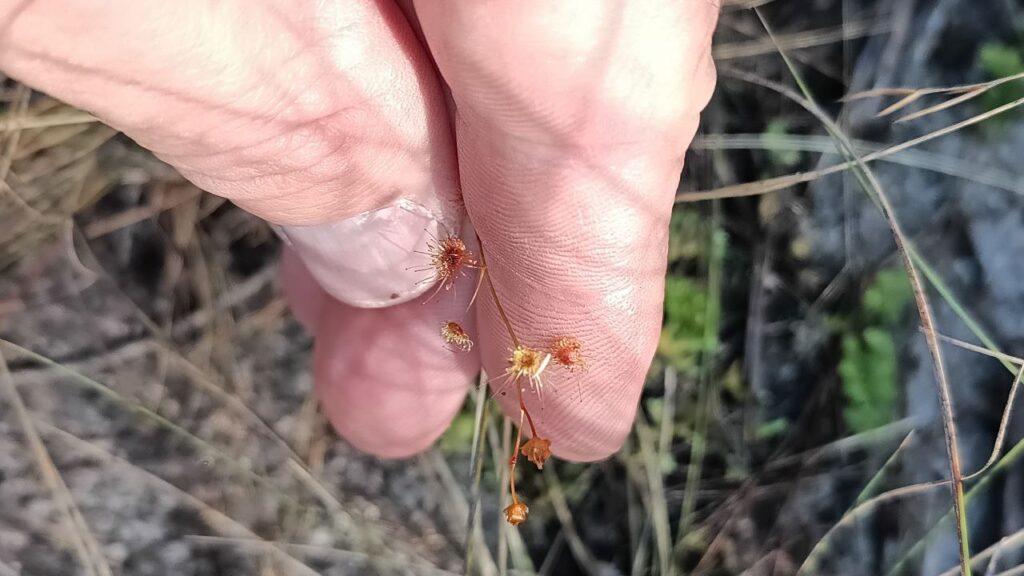
In one frame, I included my fingers for scale — and it’s staggering just how small these plants are. You’d never expect something so small to be such an efficient predator.
Sundews are best photographed in the early morning. As the sun rises, the dew drops begin to dry off, so that first light is your window for capturing them in their full, glistening glory.
Tips for Capturing the Best Sundew Shots
Shoot early: The dew drops begin to vanish as the temperature climbs.
Look closely: At first glance, they’re nearly invisible. Patience and careful scanning are essential.
Try stacking: Focus stacking can produce stunning detail, especially with a macro lens.
Think abstract: Even fragments of the plant — or a single dew-laden tentacle — can make for a striking composition.
Play with light: The droplets reflect sunlight beautifully, adding natural sparkle and colour to your shots.
Final Thoughts
Photographing sundews wasn’t just about capturing their alien beauty — it was also about learning to slow down and observe the tiny dramas unfolding underfoot. In a world obsessed with the big and the bold, these micro predators remind us that some of the best stories in nature are written in miniature.
If you’re into macro photography and looking for your next subject, don’t overlook what’s beneath your boots. You might just find yourself walking on a wonderland.
Trail camera photography has become an indispensable tool for wildlife enthusiasts, conservationists, and researchers alike. These motion-triggered photo traps allow us to observe animals in their natural habitats without disturbing them. Interestingly, trail cameras have revolutionised wildlife monitoring by capturing nocturnal and elusive species that are otherwise very difficult to see.
Over the years, I’ve met many people passionate about wildlife — some fellow photographers, others scientists focused on studying specific species. For research purposes, motion-triggered photo traps have proven invaluable for collecting data on animal behaviour, population sizes, and movement patterns. Inspired by these stories, I decided to invest in my first trail camera.
I chose the Reconyx, widely regarded as one of the best models on the market. Given that much of my work takes me to remote, often restricted areas, the Reconyx’s durability and battery longevity made it ideal for extended deployments. While working on Groote Eylandt, I had the incredible opportunity to photograph endangered Spotted Northern Quolls, bandicoots, and Rock Wallabies.
The following image shows a Rock Wallaby caught mid-smile, happily nibbling on a dried apricot I left as bait. It’s a rare glimpse of personality in a usually shy creature.
Interesting fact: Rock Wallabies have specialised padded feet that help them grip steep, rocky terrain, allowing them to evade predators with remarkable agility.
Spotted Northern Quoll
This little endangered carnivorous marsupial might look like a tiny spotted stealth master, darting through the night with fierce determination. Despite their serious hunting skills, northern quolls have a tragic weakness: their curiosity. When introduced cane toads made their way into northern Australia, the quolls — not knowing any better — began to eat them. Sadly, the toads’ toxic skin is lethal, and the quoll populations plummeted.
But there’s a silver lining: Groote Eylandt remains one of the last safe havens for this species, thanks to its isolation and absence of cane toads. Here, the quolls are thriving — and I was lucky enough to photograph one.
Funny fact: These feisty little hunters are known to take on prey almost as big as themselves — proof that they’ve got way more confidence than body mass.
Bandicoot
The bandicoot looks like it’s constantly on a treasure hunt, nose twitching as it sniffs out bugs and roots. These little diggers can burrow surprisingly fast, almost like furry little lawnmowers on a mission. If you catch one mid-hop, you might think it’s auditioning for a marsupial talent show!
Funny fact: Bandicoots poop in neat little piles, which makes it easier to spot their favourite hangouts—basically their version of putting up a “Keep Out” sign.
Next, you’ll see images of animals posing against ancient Indigenous rock paintings—a stunning reminder of the deep connection between wildlife and Aboriginal culture in this region.
While the Reconyx delivers consistently reliable images, it does have its limitations. It lacks autofocus, meaning anything not exactly at the preset focus distance can appear blurry. The standard model only uses white LEDs for flash, which can startle animals at night; the infrared option is sold separately. Also, it requires twelve AA batteries, which can be a hassle to recharge in the field. The camera’s resolution is limited to 2 megapixels, which, while sufficient for many uses, can be less detailed than newer models.
To address these downsides, I later purchased a more affordable camera with infrared night vision (invisible to most animals), higher image resolution, solar rechargeable batteries, and built-in Wi-Fi for seamless photo transfers.
Using both cameras in the harsh Tanami Desert, I managed to capture a diverse array of wildlife. The images include mulgaras, spinifex hopping mice, desert goannas, rabbits, dingoes, and feral cats to name a few.
Mulgara
The mulgara is a small, carnivorous marsupial that looks like it’s straight out of a desert adventure story. With its big eyes and twitchy nose, it’s always on high alert, darting around the spinifex like a tiny desert ninja (oops, I mean desert warrior!). Despite its size, it’s a fierce little hunter, perfectly adapted to survive the harsh desert nights.
Funny fact: Mulgaras store fat in their tails — kind of like a furry, marsupial version of a kangaroo’s pouch, except you don’t want to sit on it!
Spinifex Hopping Mouse
Tiny but mighty, the spinifex hopping mouse is a desert acrobat with giant feet made for serious boogie-boarding across the sand dunes. It’s basically the kangaroo rat’s cousin who’s always ready for a dance-off. And get this — they stash food in their cheek pouches like little furry hoarders prepping for a desert party.
Funny fact: These mice don’t drink water; they get all their moisture from their food—talk about self-sufficiency. Hydration, but make it desert chic!
Discovering Life Around a Burrow
Once, I stumbled across a well-worn burrow entrance. Curious to see who might be using it, I set up one of my trail cameras nearby. The results didn’t disappoint — during the day, a large goanna was captured sliding into the hole with all the confidence of a regular resident. Then, come nightfall, the area turned into a bit of a meeting point, with a surprising mix of animals passing through or stopping by. It’s always fascinating to see how much activity goes unnoticed right under our noses.
Funny fact: Goannas can actually run on their hind legs for short bursts—basically the reptile version of a sprinting superhero.
Dingo
Australia’s wild dog, the dingo, has earned its reputation as a clever and cunning hunter. Dingoes often look like they’re plotting world domination—those intense eyes and sly grins can be a bit intimidating. But don’t be fooled, they’re also known for their playful howls and cheeky antics around the campfire.
Funny fact: Dingoes are famous for “roositting” — they’ll sometimes hang around kangaroos, like uninvited guests at a roo party, keeping an eye on things.
Feral Cat
Feral cats are the ultimate stealth operators of the bush, moving silently and striking with lightning speed. They might look cute and cuddly, but these guys take their hunting seriously—although sometimes you’ll catch them trying to act all innocent after a less-than-graceful pounce.
Funny fact: Feral cats can make over 100 different sounds—basically, they’re the drama queens of the outback, always ready to deliver a meow-worthy performance.
Each photograph tells a unique story about the resilience and beauty of Australian wildlife, captured through the lens of technology that helps us better understand and protect these incredible creatures.
Birds on the Rock – A Reward for Patience
One of the best things about setting trail cameras is the anticipation of what you might capture. This time, I placed one overlooking a weathered rock ledge that stood out for one tell-tale reason — thick whitewash, the universal sign that birds had made it their own. Sure enough, the camera picked up a variety of feathered visitors, offering some cracking moments.
Looking Beyond the Usual Suspects
While birds are always a pleasure to photograph, the choice of location can sometimes bring unexpected visitors into frame. Pigeons, doves, and even wild cattle have occasionally wandered through — a good reminder that trail cameras often capture more than you set out for.
Whether it’s the truly wild or the everyday passing by, trail cameras have a knack for revealing those fleeting moments you’d otherwise miss. I’ll keep experimenting, and I’d love to hear what you’ve had success with — be it your camera gear, placement tips, or surprising animal appearances.
Unfortunately, my second camera has a habit of blowing out the highlights — a frustrating flaw. It does raise the question: What trail cameras are you using? I’d love to hear from others in the field — which models are you relying on, and how do they perform when it comes to dynamic range and colour accuracy? Let me know in the comments — I’m especially keen to find one that handles highlights in a better way.
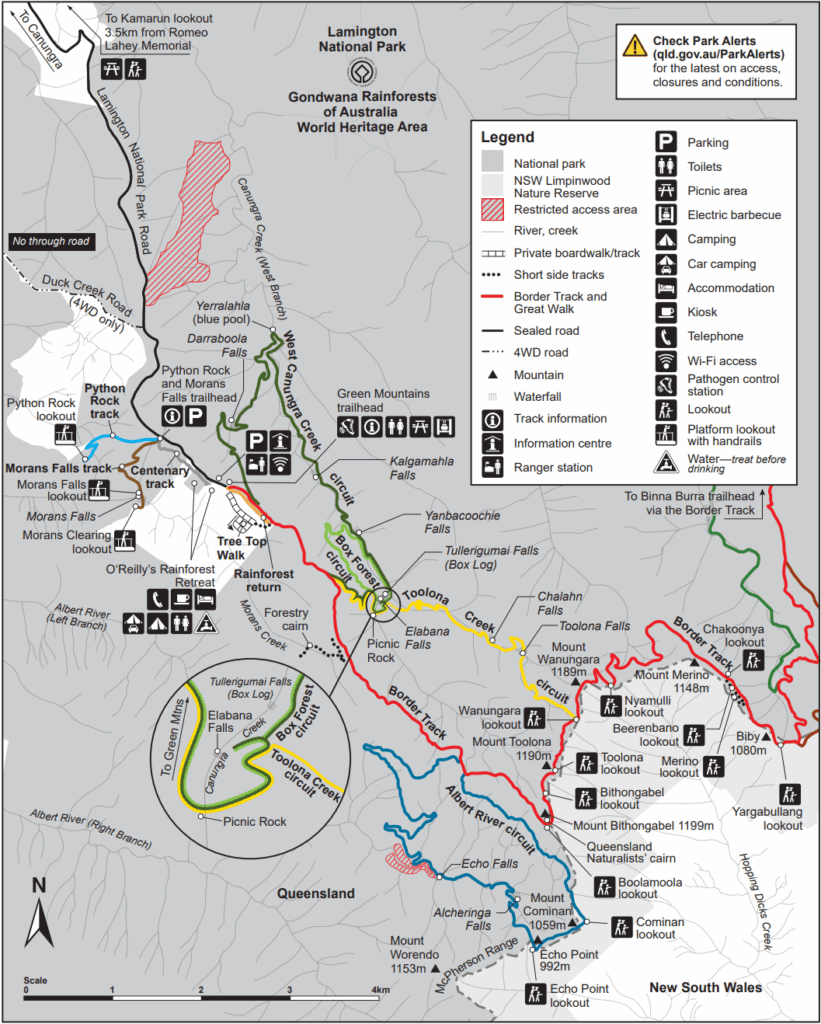
Nestled within the Gondwana Rainforests of Lamington National Park in southeast Queensland, O’Reilly’s is a treasure trove of natural beauty. This World Heritage-listed area boasts ancient Antarctic beech trees, rare wildlife, and a seemingly endless network of rainforest trails. For anyone with a passion for nature and photography, it’s a place where every step offers a new scene waiting to be captured.
Getting to this part of the world is an adventure in itself. From where we live, it’s about a two-hour drive, including a winding hour-long stretch through mountain roads. Over the years, we’ve visited O’Reilly’s a handful of times, but never quite made it far enough into the trails to see the waterfalls—until now.
On this trip, I set out with my two sons to explore a 13-kilometre loop that took us to five spectacular waterfalls over the course of five hours. It was our first time completing this hike, and the experience exceeded all expectations.
Here’s a look at each of the waterfalls we visited, in the order we reached them:
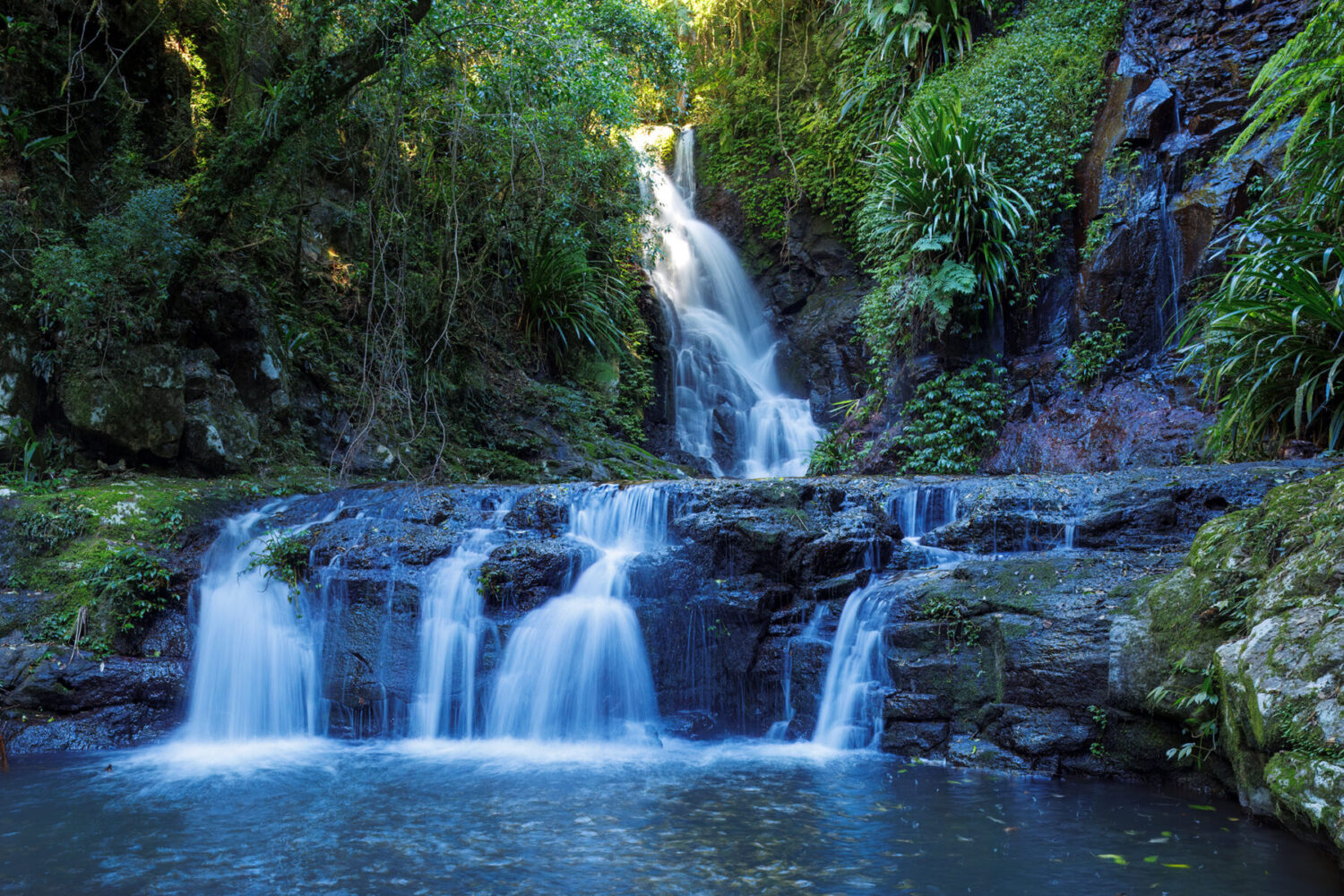
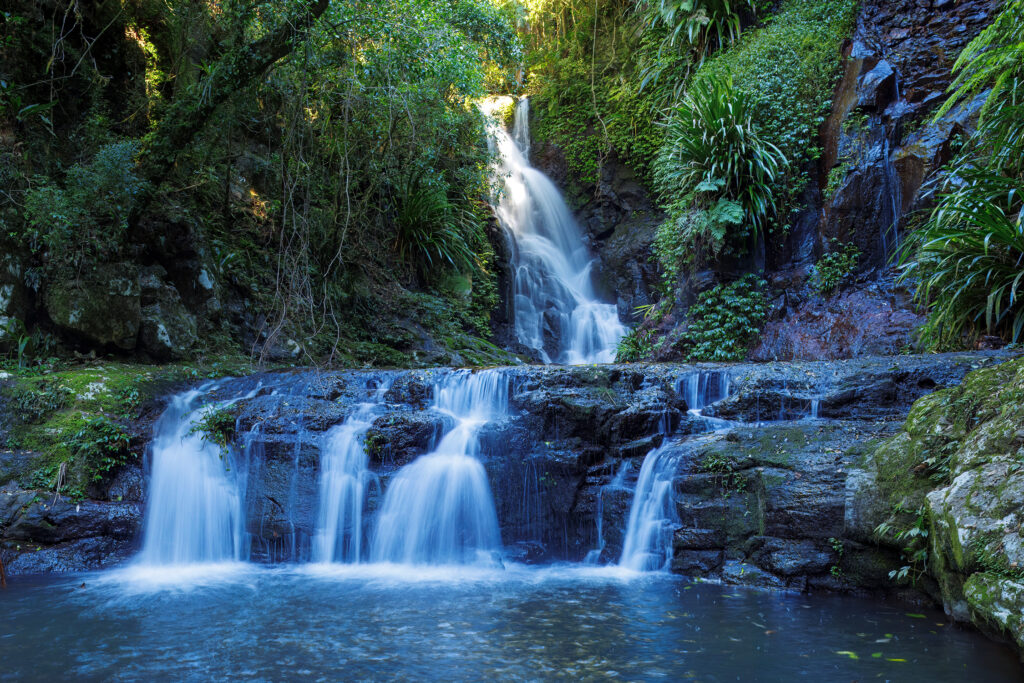
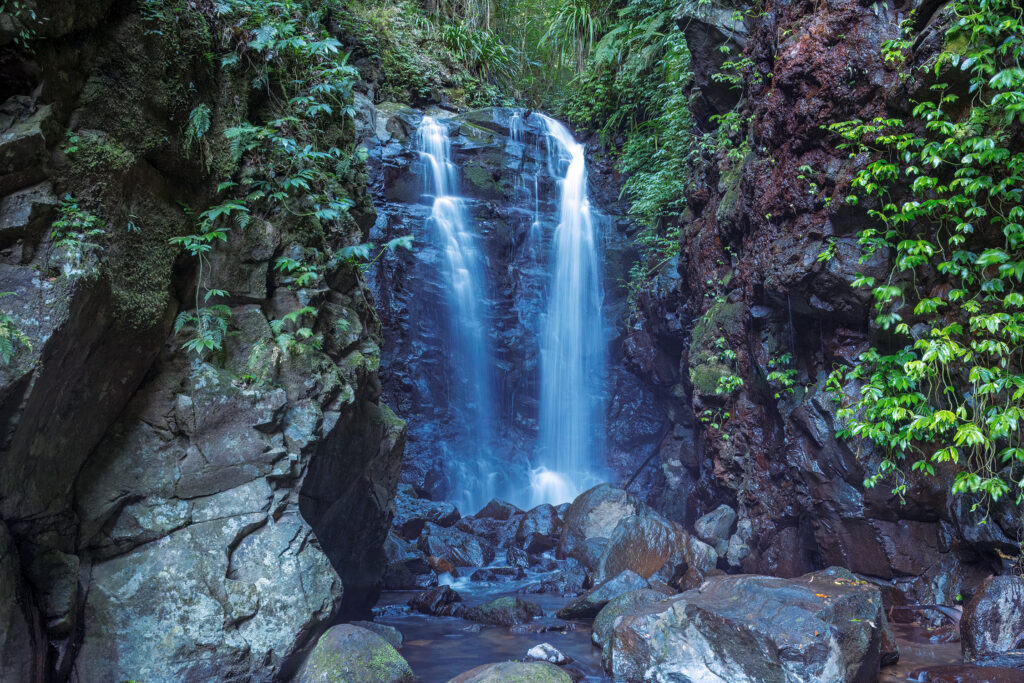
🌿 1. Elabana Falls Elabana Falls is, without doubt, the jewel of this trail—and my personal favourite. The falls cascade gracefully over a series of moss-covered ledges into a serene rock pool below. Surrounded by ancient rainforest and accessible via the popular Box Forest Circuit, Elabana has a fairy-tale quality that makes it one of the most photographed spots in Lamington. The light filtering through the canopy above creates an ethereal atmosphere, especially in the early morning.
This is a place where time seems to slow. We spent the longest here, trying to capture the perfect long exposure shot of the water as it veiled over the rocks. A must-see for any nature lover or photographer.
🌿 2. Chalahn Falls Just a short hike further, Chalahn Falls offers a striking contrast. These falls are taller and more dramatic, plunging vertically down a dark cliffside wrapped in vines and ferns. The surrounding rainforest is particularly dense here, creating a mystical, enclosed feel. The track narrows and becomes more rugged as you approach, giving the waterfall an almost secretive allure.
The water plunged steadily over the rock face during our visit, framed by lush ferns and hanging vines. Although it was our first time seeing Chalahn Falls, it was every bit as beautiful as we’d hoped. The dense greenery and dappled light created a moody, atmospheric setting that made it a great spot for photography.
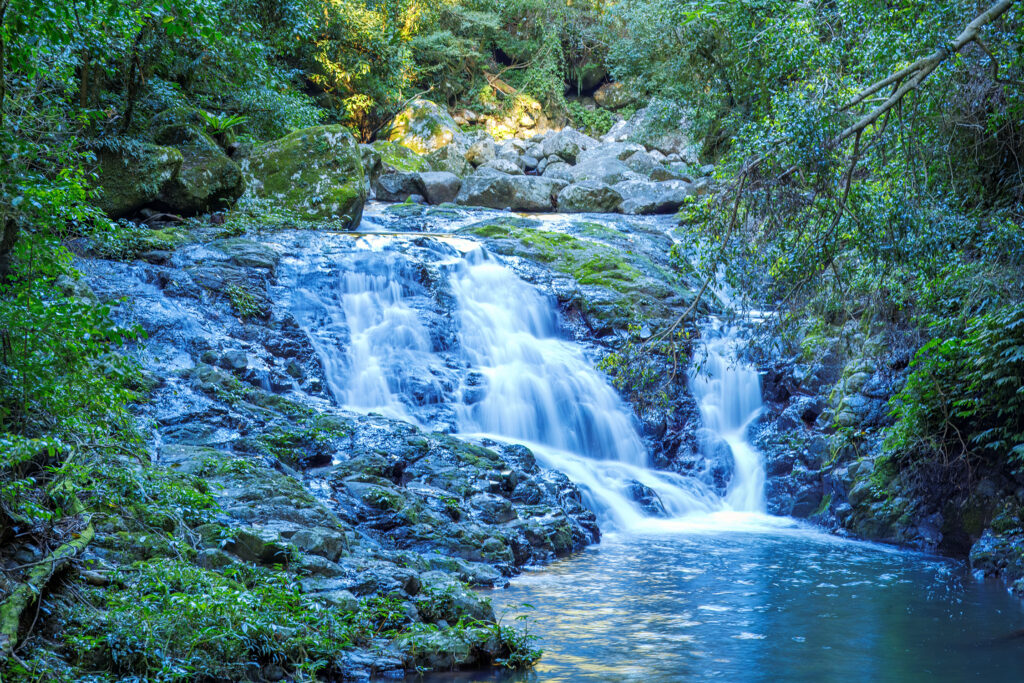
🌿 3. Toolona Falls Toolona Falls is where the trail really comes alive with the sounds of rushing water and bird calls echoing through the forest. These falls spill down in a single, wide curtain and are set deeper into the heart of the park. The path here is wetter and more slippery, so good boots are essential.
Toolona has a wild, untouched character that’s hard to beat. It’s also the perfect spot to pause for a snack and just soak in the sights and sounds of the rainforest.
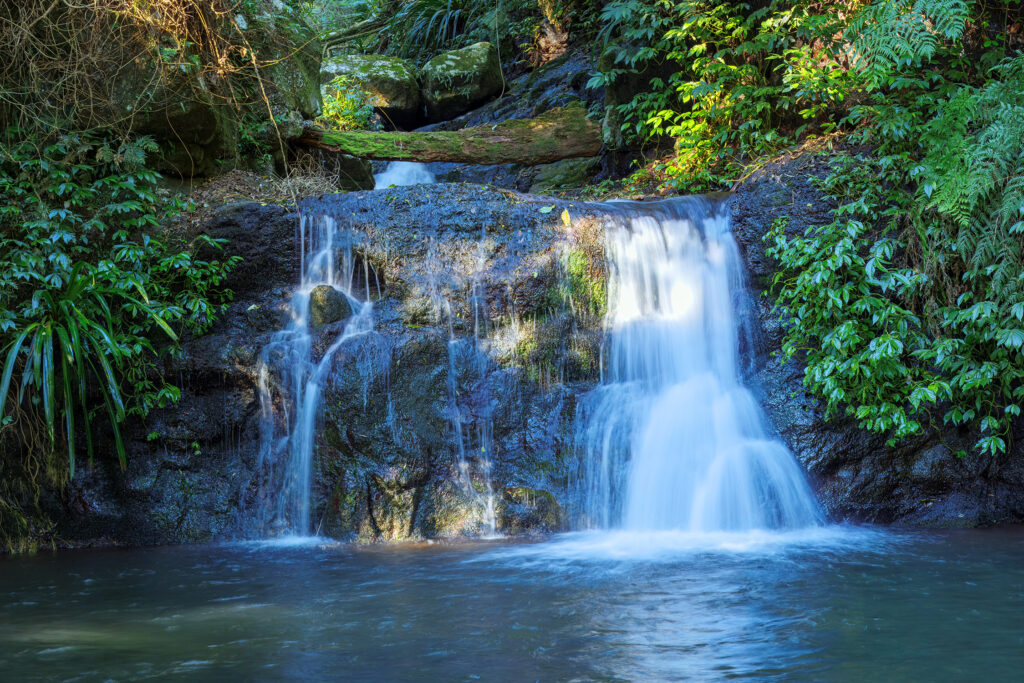
🌿 4. Box Log Falls Box Log Falls offers a beautiful reward for those willing to follow the winding trail along West Canungra Creek. These falls are broad and tall, tumbling over black volcanic rock surrounded by lush palms and towering trees. The nearby log bridge and stepping stones add a sense of adventure.
The area is also rich in birdlife—whipbirds and bowerbirds accompanied us here, making it a fantastic stop for both photographers and young explorers.
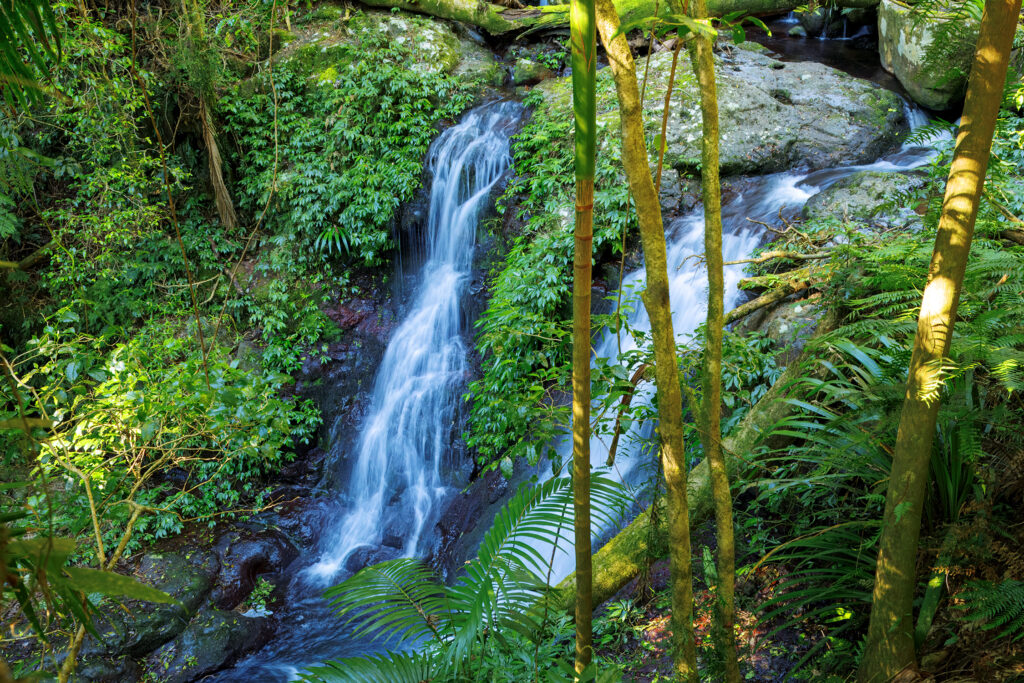
🌿 5. Yanbacoochie Falls Our final stop was the lesser-known but equally enchanting Yanbacoochie Falls. Though not as tall or dramatic as the others, it has a quiet charm. The water slides over smooth rocks into a small pool tucked into the forest. It feels more remote, and we had it entirely to ourselves—a perfect way to end the hike.
There’s a serenity to this spot, a kind of whisper from the rainforest. It’s one of those places that rewards the effort it takes to find it.
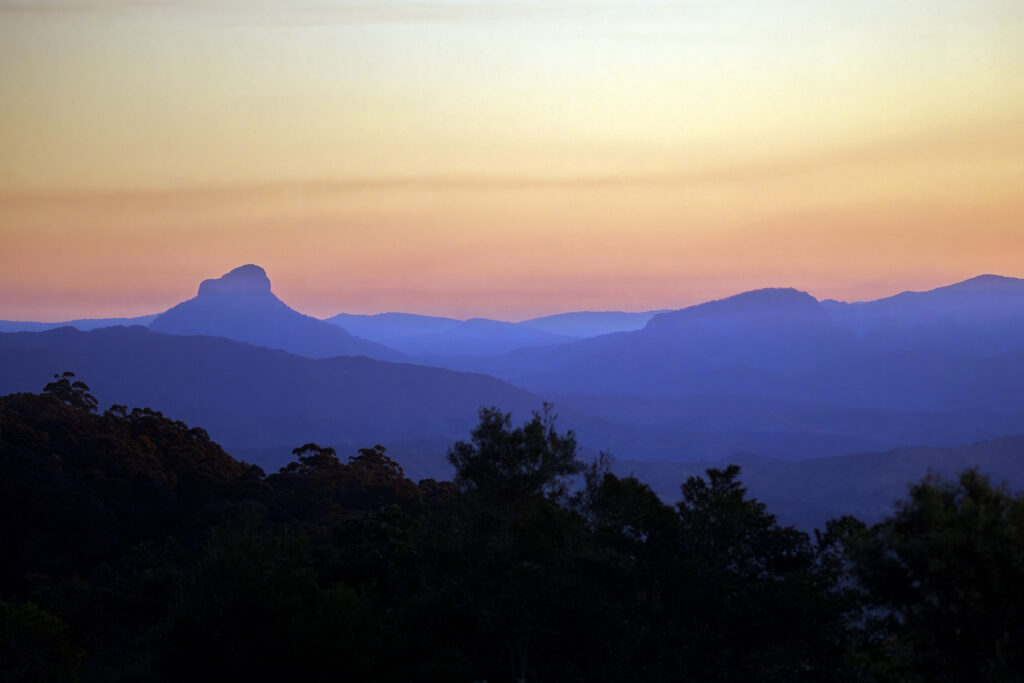
After we wrapped up the walk, a bit tired but buzzing with excitement, we stayed to watch the sunset paint the sky behind the distant mountain ranges, casting a stunning layering effect over the landscape.
Of all the waterfalls we visited, Elabana Falls stood out to me as the most breathtaking. There’s something truly magical about the way it cascades gently over the mossy rocks, surrounded by the dense, green rainforest. It was a spot I could have stayed at for hours, just soaking in the stillness and beauty. Each of the five waterfalls has its own charm, though—and I’d love to hear what you think. Based on the photos I’ve shared, which one is your favourite? Let me know in the comments below!
The Lewin’s Rail (Lewinia pectoralis) is one of Australia’s most secretive wetland birds, often heard but rarely seen. These small, shy rails inhabit dense reed beds and swamps, typically venturing out only in the early morning or late evening. Their elusive nature makes them a sought-after species for many birders and wildlife photographers – a real prize sighting. Despite years of birdwatching, I had never laid eyes on one until now.
Interesting Facts About Lewin’s Rail
Distinctive Call
Despite being hard to spot, they have a loud, squealing or grunting call, often described as a “pig-like” squeal. This call is usually the first sign of their presence.
Habitat Specialists
They prefer dense, swampy wetlands, especially reed beds, sedgelands, and freshwater marshes. They rely on thick vegetation for cover and rarely stray into the open.
Wide but Patchy Distribution
Lewin’s Rails are found throughout eastern and southeastern Australia, with scattered populations in Tasmania, Victoria, New South Wales, Queensland, and parts of South Australia. There are also subspecies in New Guinea, the Philippines, and parts of Southeast Asia.
Small but Agile
They’re small birds—typically around 20–30 cm in length—but move quickly through dense reeds and undergrowth, making them even harder to spot.
Named After a Naturalist
The species is named after John Lewin, one of Australia’s first colonial artists and naturalists, who documented many native species in the early 19th century.
Extremely Secretive Nature
Lewin’s Rails are incredibly shy and elusive. They’re more often heard than seen, making them a real challenge—and a prize—for birdwatchers and wildlife photographers.
The opportunity to see the bird came thanks to a group of birders from Victoria who reported a Lewin’s Rail sighting on eBird. What followed was a flurry of observations, suggesting the bird had taken up a semi-regular presence in the area. A friend of mine, living nearby and closely tracking the exact location, tipped me off. The potential to photograph such a rare and shy bird was too good to pass up. Special thanks to Graham D for his keen eye and timely heads-up.
Even more remarkable, this entire encounter took place right in the heart of Brisbane’s CBD. The experience was equal parts surreal, amusing, and unforgettable. Usually, when I photograph wildlife, the outside world fades away—just me and my subject, enveloped in the natural landscape. But this time, I was crouched beside an artificial pond, surrounded by concrete, steel, and glass, with the ever-present hum of city life vibrating in the background. If I’d turned my head, I would have seen towering skyscrapers framing the scene.
To help paint the picture, I’ll be including two images below: one showing the surrounding skyline of skyscrapers, and another of the artificial pond itself—complete with pumped water that gives life to this small, urban pocket of habitat. It’s hard to believe such a secretive wetland bird would choose to appear in a place like this, but that’s part of what made the moment so special.
I’ve never had a wildlife encounter amid such urban chaos. As soon as the cameras started clicking, curious passersby stopped in their tracks, trying to guess what mysterious creature had drawn our attention. It was a strange but fascinating collision of nature and civilisation.
The wait for the bird to show was long, but certainly not wasted. We were rewarded with several brief yet clear views, and I managed to capture a handful of satisfying shots. You’ll find some of my best images below.
Most importantly, I made some valuable connections with like-minded people who share the same passion for birds and photography. We’ve already started planning to collaborate—sharing experiences, tips, and ideas to help each other grow and improve the quality of our work. It’s always rewarding when a rare wildlife encounter not only results in great photos but also sparks new creative partnerships.
Few birds capture the spirit of freedom and precision quite like swallows. Sleek and nimble, these aerial acrobats are built for speed and endurance, with their slender bodies, forked tails and long, pointed wings. Swallows can cover vast distances during migration and are capable of feeding, drinking, and even sleeping mid-flight. In Australia, the swallows and martins are a familiar sight, often seen skimming low over fields and water, hunting insects on the wing with astonishing agility. But as elegant as they are to watch, they’re notoriously difficult to photograph—especially in flight.
When I first picked up a camera, capturing a swallow mid-air quickly became a personal challenge. I remember asking a more experienced mate, somewhat in desperation, “How do you photograph a swallow in flight?” His reply, with a wry grin, was simply: “You don’t.” Ironically, he’d managed a decent shot of one in flight himself, which only stoked my determination. That was the moment this mission quietly began. Over the years, I’ve come to realise that the real difficulty in photographing swallows doesn’t lie solely with the camera gear—though even the most advanced autofocus systems can be pushed to their limits. The real test is a combination of factors: the gear, the autofocus speed, and most critically, the photographer’s own hand-to-eye coordination. Swallows are fast, agile, and unpredictable in flight, often changing direction in the blink of an eye. Keeping one in the viewfinder—especially when using a long telephoto lens—is no easy feat. In many ways, capturing a sharp, well-composed image of a swallow in mid-flight is the ultimate challenge for both the equipment and the person behind it.
I tried my luck in freshly mown soccer fields, where small flocks of swallows would swoop for insects—unsuccessfully. I searched for locations where their flight might be more predictable, but again, without much joy. Then, five years into this quiet quest, I stumbled across a breakthrough: a drying puddle in the middle of a desert —the only source of water for kilometres. That afternoon, swallows descended in their hundreds to drink on the wing. I dropped flat on the ground, crossed my fingers, and hoped the sheer number of birds and the small size of the puddle might work in my favour. It did. Birds returned the next day as well, following the same pattern, and I finally got the shots I’d been chasing for half a decade.
I’m sharing the results here with you, and with them, a friendly challenge: do you have a swallow-in-flight photo? If not, I can promise this—when you do get one, it’s immensely satisfying. Good luck out there!
When I first picked up a camera and started photographing wildlife—especially birds—I was obsessed with one thing: getting closer.
It was all about filling the frame. I wanted to see every feather, every glint in the eye, every tiny detail that usually goes unnoticed. At first, it felt like a technical challenge—how close could I get without disturbing the bird? Could I use the longest lens possible, or outsmart the subject with patience, camouflage, or clever positioning? There was an undeniable thrill in it.
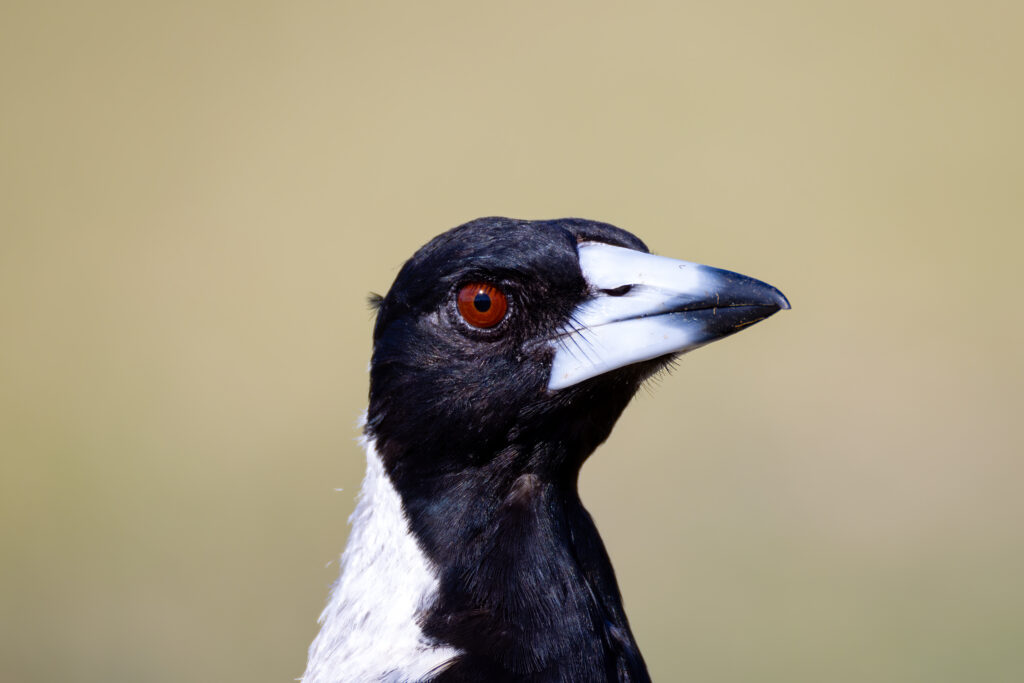
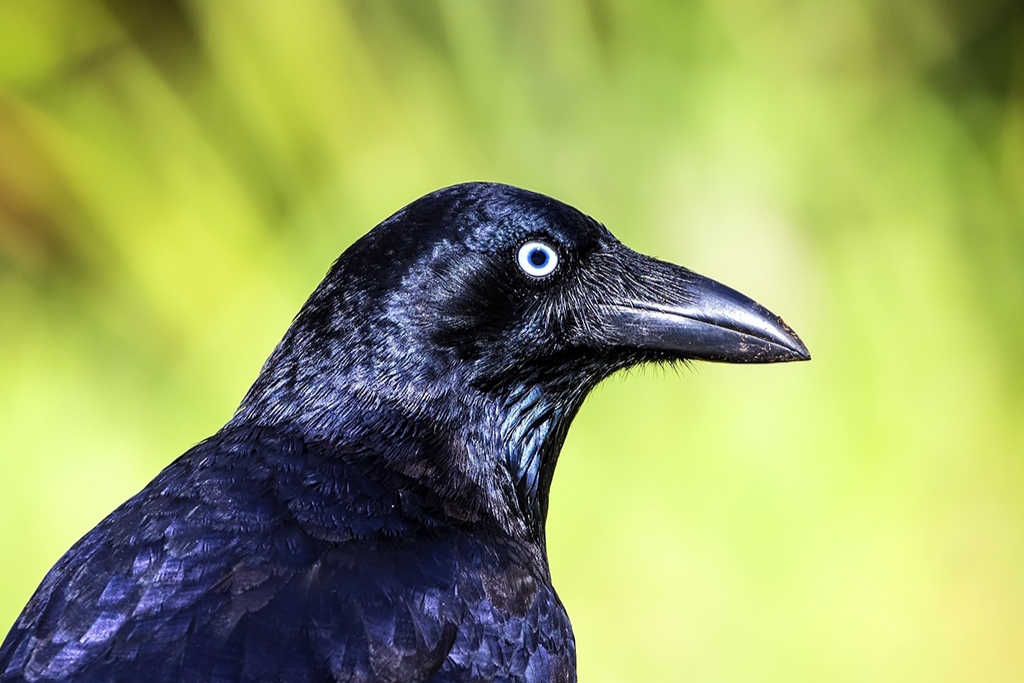
Eventually, I started taking tight bird portraits—crisp, detailed shots where the subject dominated the frame. These moments felt like small victories. I remember the first time I captured a full-frame shot of a bird with perfect sharpness and catchlight in the eye. I was proud, even a little bit smug. I had gotten the shot.
But over time, my priorities started to shift.
Understanding the Language of Light
Once I had some of these portraits under my belt, I began to notice something missing. The photos were technically solid, but sometimes they felt flat—lacking mood or atmosphere. That’s when I began to pay more attention to light, background, and composition beyond the subject.
I realised that even the best lens couldn’t fix harsh midday light or a cluttered background. Some locations only worked in the soft hues of morning; others came alive in the golden glow of late afternoon. The angle of the light, the direction of the wind, and even the colour of the water or sky behind the bird—all of it mattered. I began scouting locations based on how the light interacted with the environment, not just where birds were most abundant.
This shift was subtle at first, but profound. I stopped chasing just birds, and started chasing conditions. My photography became more intentional.
The Role of Patience: More Than Just Focal Length
As I became more experienced, I also discovered something about how we approach proximity in wildlife photography. Sure, you can get a 600mm lens, maybe even add a 1.4x or 2x converter, and get those tight portraits from a distance. And that certainly works—it’s how many professionals operate.
But I also found another way: using a shorter lens, like a 400mm, and relying on patience instead of reach.
When I began approaching birds slowly, respectfully, and without pressure—waiting for them to come to me or relax in my presence—it started to feel like something more. It wasn’t just about taking a photo anymore; it was about building trust. In those moments, I wasn’t just an observer—I felt like I was becoming part of their world, part of their family.
This kind of closeness, built through time and presence rather than gear, made the final image feel more honest, more intimate. Once you master that skill, it expands naturally beyond birds—into mammals, reptiles, even insects. It’s a way of seeing, not just a way of shooting.
The Search for the Rare—and the Lessons of Disappointment
After photographing many of the local and familiar birds, my curiosity turned toward the more elusive species. I started planning trips, seeking out remote or specific habitats, tracking down birds I’d never seen before.
But often, these long efforts didn’t result in great photographs. The birds didn’t show up. Or if they did, the lighting was poor, the background distracting, or the moment just didn’t materialise. I returned from many of these trips without a single keeper shot.
It was disheartening. I began to ask myself: Whytravel so far just to come back with nothing? That’s when I began to reconsider what I was really looking for with my camera.
Rediscovering the Familiar
After a few too many empty-handed journeys, I shifted focus again—this time back to the birds close to home. I decided to return to the local wetlands and bushland with a new perspective and greater intentionality.
That’s when I started photographing ducks.
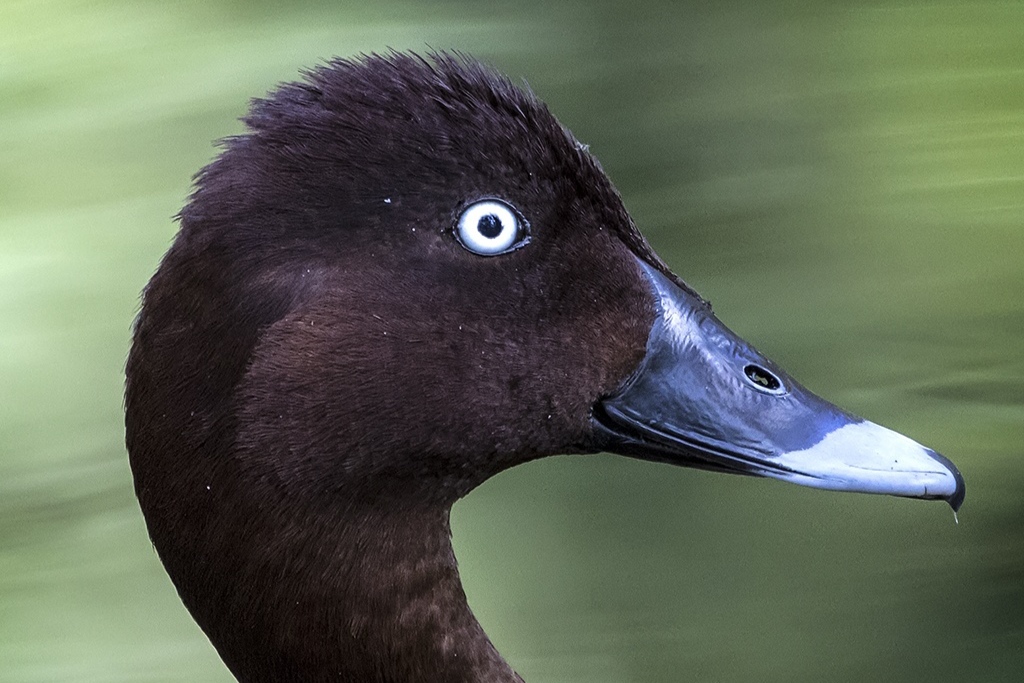
Ducks are everywhere. I used to overlook them, assuming I’d already “gotten” those shots. But I hadn’t. Not really. One morning, I found myself watching a hardhead duck bathed in perfect light. I crouched down, framed it tightly, and clicked. That photo remains one of my favourites to this day.
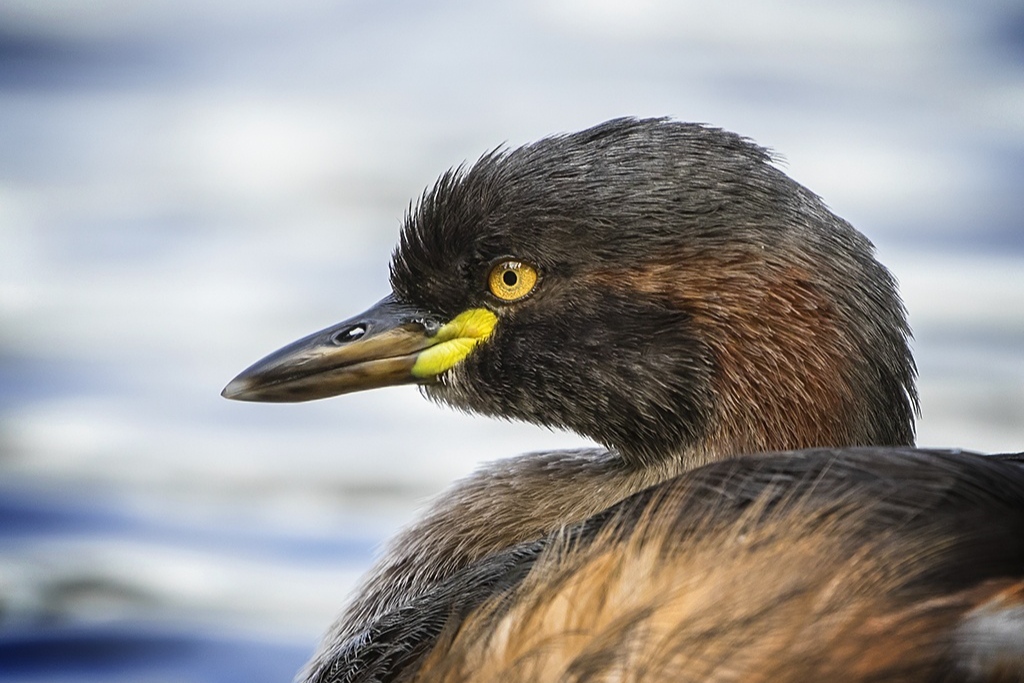
What started as an experiment quickly became a personal project. I began collecting duck portraits—each one crafted carefully, with attention to detail and emotion. Over time, I expanded this approach to other birds I’d previously overlooked: grebes, herons, moorhens, cormorants. I wasn’t just taking pictures anymore. I was telling quiet stories.
Looking Ahead: Embracing the Environment
Later in my photography journey, I began to move beyond just the bird itself. I started enjoying wider angles—photographing not only the subject but the environment it lives in. These images feel more narrative, more immersive. You don’t have to be extremely close to the bird, but the environment becomes more demanding. Light, habitat, background—all need to work in harmony.
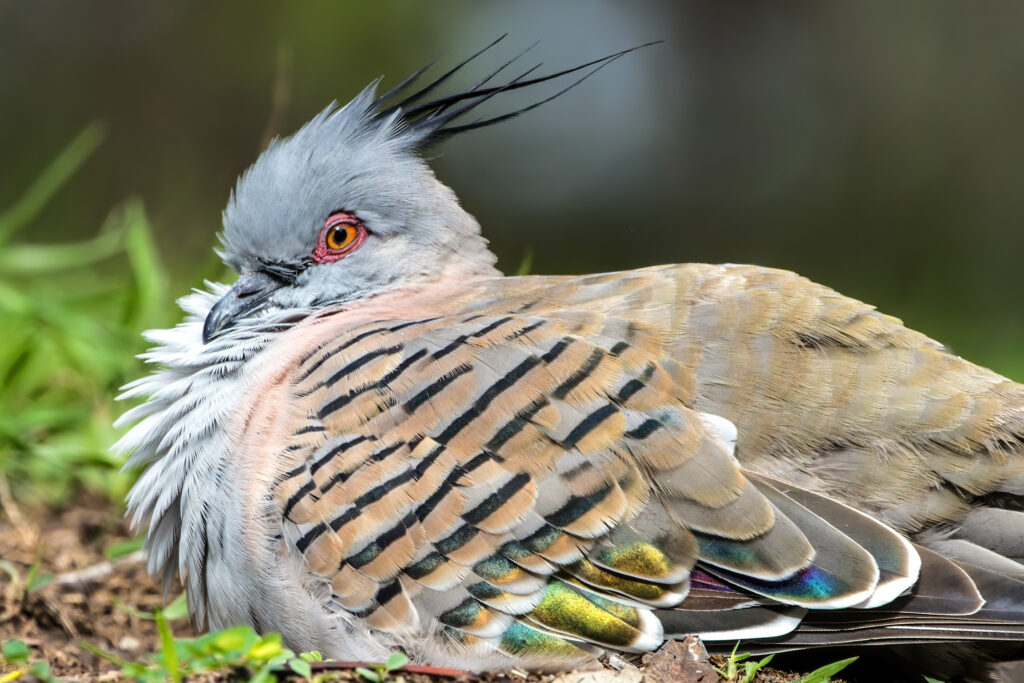
That’s a topic I’ll dive into more in the future posts. But for now, let’s enjoy these portraits of everyday birds—captured with patience, respect, and a deep appreciation for the wildlife that shares our local spaces.