
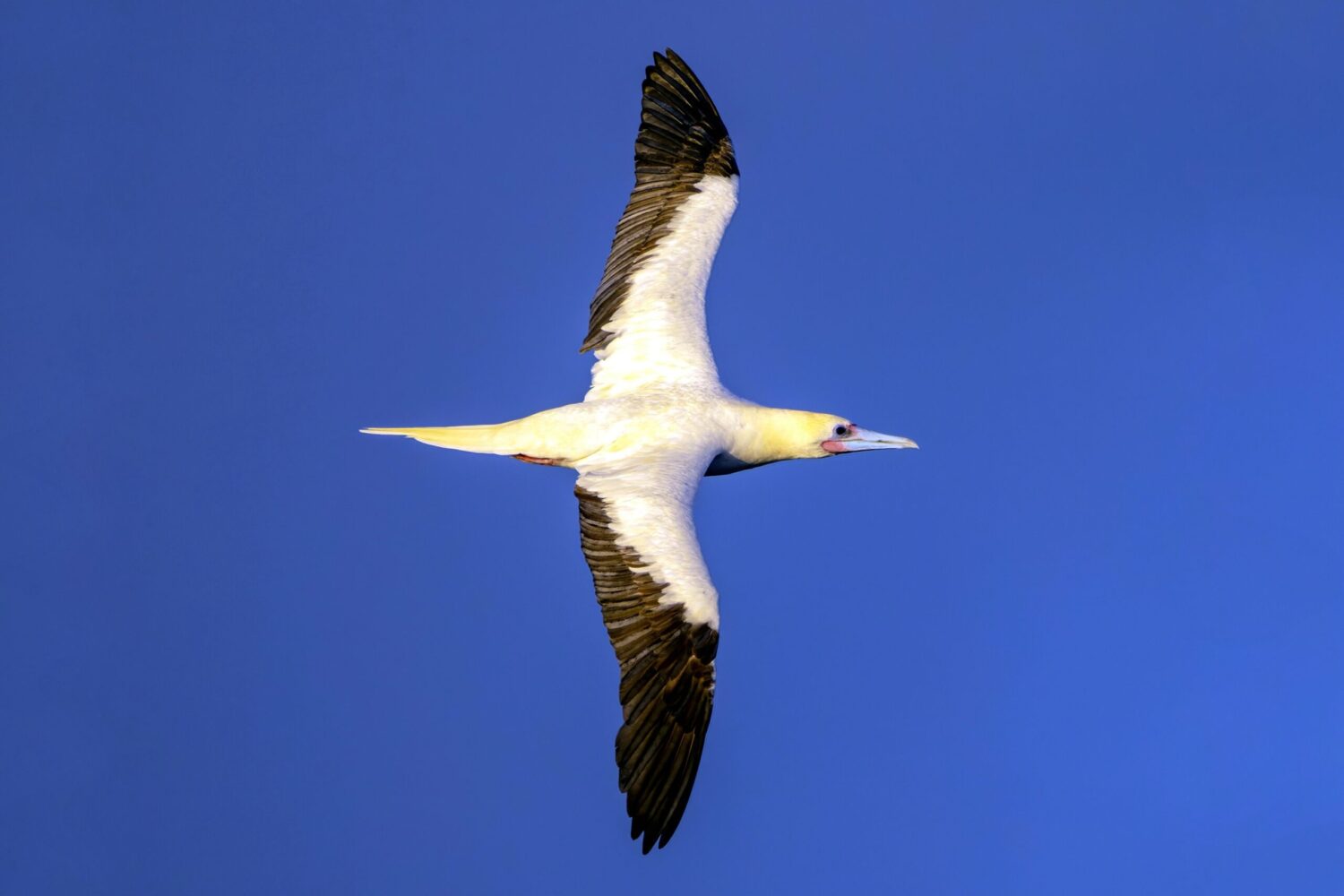
Fun & Fascinating Facts About Australia’s Boobies
- Boobies are named after their clumsiness. Early Spanish sailors called them bobo, meaning “fool” or “clown”, because the birds were so trusting they’d waddle right up to people on deck. Not the most flattering origin story, but it stuck.
- They’re exceptional aerial hunters. Boobies dive from impressive heights—sometimes over 20 metres—spearing into the ocean like feathery missiles to snatch fish and squid. Their bodies are built for it, with shock-absorbing skulls and tightly folded wings.
- Aussie waters are prime booby territory. While they’re more commonly associated with tropical islands across the Indo-Pacific, Australia has thriving populations on offshore islands from the Great Barrier Reef to the remote west coast.
- They’re devoted parents (most of the time). Boobies typically lay just one egg, and both parents take turns incubating and feeding their chick. The nest is often little more than a scrape or a simple stick platform—practical, not fancy.
- Their courtship dances are brilliantly odd. Expect sky-pointing, foot-lifting and all sorts of theatrical moves. The red-footed booby’s high-stepping foot display is particularly charming.
- They’re surprisingly quiet birds. Unlike gulls or terns, boobies communicate mostly with soft grunts, honks and whistles—often from inside the colony where their nests cluster tightly together.
- Red-footed boobies sport—you guessed it—bright red feet and come in several colour morphs.
- Brown boobies are sleek, dark and super agile in flight.
- Masked boobies show off a bold black facial mask and clean white plumage.
Australia’s Boobies Up Close: Life on the Wing Above the Deep Blue
I’m a bit prone to motion sickness and admittedly nervous about going on dedicated seabird-watching trips, especially when they involve small boats. Instead, I photographed these boobies from a large cruise ship, which I managed to turn into a surprisingly successful bird-watching adventure. I certainly wasn’t expecting to spot all three species at once, but the ship’s wake seemed to send flying fish leaping from the water—an ideal invitation for the birds to follow along, dive after the fish and show off from all sorts of angles. I’m especially fond of the deep blue tones of the open ocean in the background, which create a brilliant contrast and make the birds really stand out.
Leave a Reply