
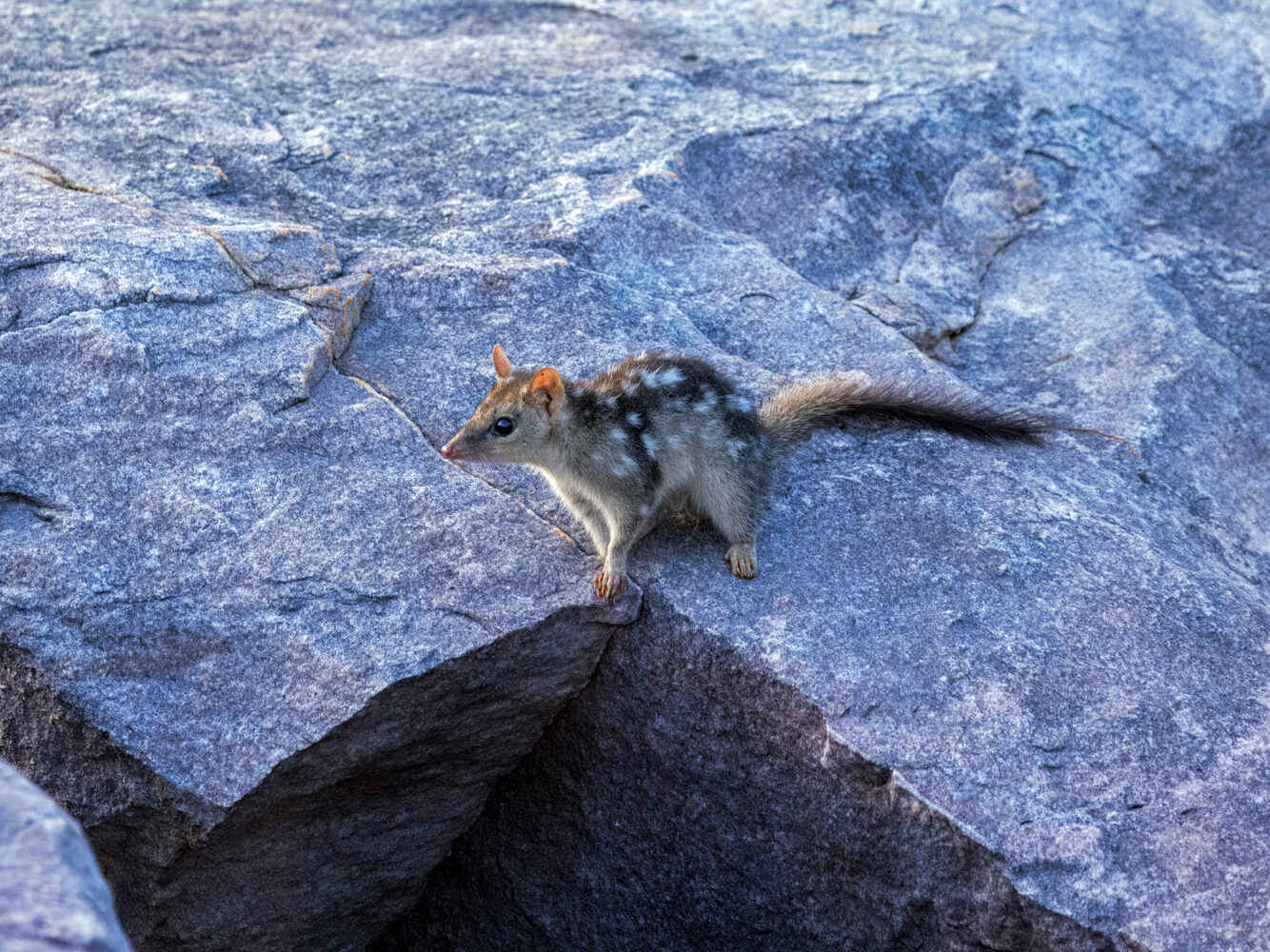
The Australian bush changes after dark. As the heat fades and the night insects begin their chorus, a small spotted predator emerges from the rocks and hollow logs. The northern quoll is quick, curious, and surprisingly fierce for its size. Photographing this elusive marsupial means entering a world most people never see—one of midnight hunts, agile climbs, and a creature fighting to survive in a rapidly changing landscape.
Fun Facts about Northern Quoll
- They’re Australia’s tiny “tiger cats” – Despite their small size (about the length of a ruler plus a tail), northern quolls are fierce predators. Their reddish-brown fur covered in white spots has earned them nicknames like “native tiger cat.”
- They’re carnivorous marsupials – Unlike kangaroos or koalas, quolls are meat-eaters. A northern quoll’s diet can include:
- insects
- spiders
- small reptiles
- birds
- small mammals
- They’re opportunistic hunters and excellent climbers.
- Males live shockingly short lives – One of the most dramatic facts: male northern quolls die after their first breeding season. During mating season they go into a hormone-driven frenzy—often mating with multiple females for hours at a time, barely eating or sleeping. The stress leads to immune collapse and death, meaning most males live only about one year.
- They’re night explorers – Northern quolls are nocturnal, spending their nights roaming rocky outcrops, forests, and savannas in search of food. During the day they sleep in tree hollows, rock crevices, or termite mounds.
- Their feet are built for climbing – They have rough pads and sharp claws, allowing them to scale trees, cliffs, and even buildings surprisingly well.
- Cane toads are one of their biggest threats – The arrival of the invasive Cane Toad has devastated many northern quoll populations. Quolls try to eat them but are poisoned by the toads’ powerful toxins. Conservation programs now train quolls to avoid toads by giving them small, nausea-inducing meals made from toads so they learn the taste is bad.
- Females have only six teats – a female quoll typically gives birth to 20–30 tiny young, but she only has six teats, so only the strongest six survive to develop in the pouch.
- They once lived across northern Australia – Today they’re mostly found in northern parts of Australia, especially rocky habitats across regions like Northern Territory, Western Australia, and Queensland.
- They’re endangered in the wild – Because of threats like cane toads, feral cats, habitat loss, and fire, the northern quoll is listed as endangered. Conservation groups and zoos are working hard to protect them.
Dusk in Quoll Country
While working in the Northern Territory, I was lucky enough to spend time on Groote Eylandt, one of the few places where northern quolls still thrive. Photographing them required patience more than anything else. I would arrive at a likely spot before sunset and sit quietly, trying not to move while the bush gradually shifted from day to night. Although these little predators are technically nocturnal, they sometimes emerge a few minutes before the sun actually disappears. On several evenings a curious quoll would appear while there was still plenty of light, which meant I was able to capture a few rare daylight photos of these normally night-active animals.
Where Quolls Still Rule
One reason Groote Eylandt is such an important refuge for the Northern Quoll is the absence of the invasive Cane Toad. Across much of northern Australia, cane toads have devastated quoll populations because the animals attempt to prey on them and are poisoned by their powerful toxins. Groote Eylandt, however, remains one of the few places where toads have never established a population. Strict biosecurity controls on incoming ships and cargo help prevent them from reaching the island. Without this deadly invader, northern quolls here can still live much as they once did across the mainland—roaming the landscape as one of the area’s small but dominant predators.
Moments with a Northern Quoll
The photos below capture a few moments I was lucky enough to witness while observing northern quolls on Groote Eylandt. Watching these small predators emerge from the rocks, sniff the air, and cautiously explore their surroundings was an unforgettable experience. Every encounter felt slightly different—sometimes just a quick appearance before they vanished into the bush, other times a curious individual lingering long enough for a few frames. If you’ve ever seen or photographed a Northern Quoll yourself, I’d love to hear about it. Feel free to leave a comment and share your own experience or tips for spotting these incredible animals in the wild.
Leave a Reply